KanSynLM: Overcoming Spectral Bias in Drug Synergy Prediction via Wavelet KANs and Large Language Models
KanSynLM is a novel computational framework designed to accurately predict drug synergy. By integrating Wavelet Kolmogorov-Arnold Networks (KANs) with robust Large Language Models (LLMs), it overcomes the spectral bias typically encountered in deep learning models, enabling high-fidelity representations of drug-drug-cell line interactions.
Motivation
Identifying synergistic drug combinations is critical for precision oncology, yet the vast combinatorial search space makes exhaustive experimental screening impractical. Although deep learning methods have shown promise, two fundamental challenges persist: the intrinsic spectral bias of standard MLP regressors, which limits their ability to capture sharp, localized synergistic signals; and extreme class imbalance in large-scale screening datasets, where synergy rates fall below 1%, leading to a severe degradation in minority-class recall.
Results
We present KanSynLM, which directly overcomes these limitations. It utilizes locally-adaptive Wavelet KANs to resolve sharp, localized synergistic signals often missed by MLP spectral bias, and introduces a sparsity-aware prior calibration mechanism to prevent the severe degradation of minority-class recall caused by background imbalance. It leverages locally-adaptive activation functions to resolve sparse synergistic signals, and adopts mechanism-of-action-aware representations from biomedical text to contextualize drug–cell line interactions. Additionally, a dataset-sparsity-aware calibration mechanism is introduced to mitigate bias toward the non-synergistic majority. Evaluated on 678,302 drug–cell line pairs across six benchmarks spanning diverse tissue types, KanSynLM outperforms the strongest baselines by up to 39.07% in F1-Score with a leading Pearson correlation (r = 0.78), and remains robust under long-tail, few-shot, and cold-start conditions. Importantly, the model's learned representations recapitulate established pharmacological mechanisms, including PARP1-trapping DNA damage amplification and Src-mediated bypass blockade of EGFR resistance.
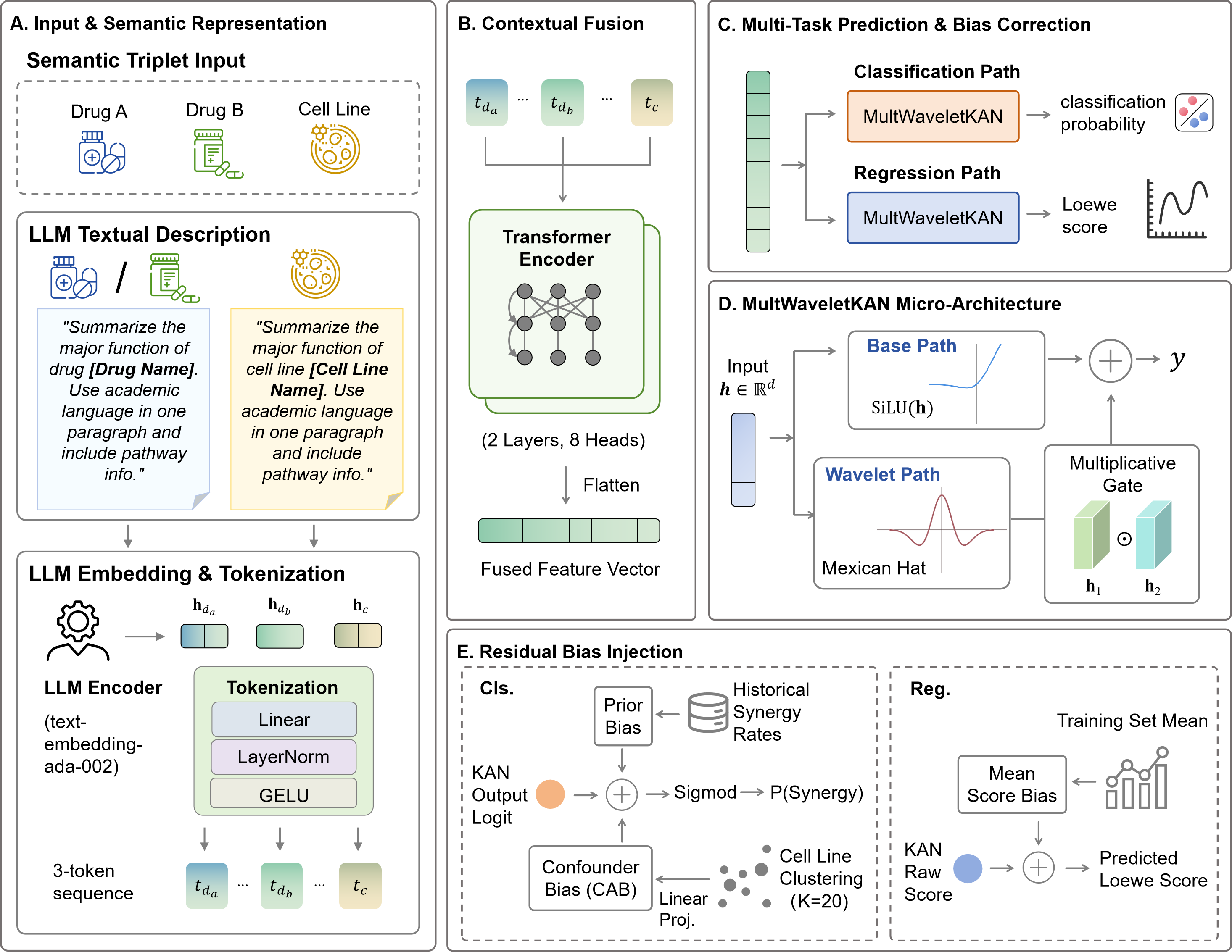
Figure 1. The KanSynLM architecture for drug synergy prediction. (A) Input & Semantic Representation: Standardized query templates extract deep functional semantics of drugs and cell lines. A pre-trained biomedical language model encodes these textual descriptions, which are then tokenized and normalized into a unified semantic sequence. (B) Contextual Fusion: A 2-layer, 8-head Transformer encoder utilizes multi-head attention to dynamically fuse tokens, capturing context-dependent drug–cell interactions. (C) Multi-Task Prediction: The flattened representations are routed into parallel classification and regression paths. Both predictive branches replace standard MLPs with independent MultWaveletKAN layers. (D) MultWaveletKAN Micro-Architecture: A zoom-in view of the KAN layer, which integrates a global Base Path with a localized Wavelet Path. A multiplicative gate explicitly models high-order, non-linear chemo-genomic interactions. (E) Residual Bias Injection: Distinct bias calibration mechanisms are strictly applied to both predictive tasks. The classification branch (Cls.) incorporates a historical Prior Bias and a Confounder Adjustment Bias (CAB) derived from cell line clustering (K=20), while the regression branch (Reg.) utilizes a Mean Score Bias to calibrate the continuous synergy prediction.
Prediction Server
Instructions
Welcome to the KanSynLM prediction server. You can choose to process data in two ways:
- Batch (CSV): Upload a file with
Drug_A,Drug_B, andCell_Linecolumns. - Single (Text): Manually enter the names to get instant results on the screen.
Example Data
You can use the following verified pairs to test the model:
| Drug_A | Drug_B | Cell_Line |
|---|---|---|
| Fostamatinib | 915019-65-7 | TC-32 |
| MRK003 | doxorubicin | OV90 |
| Asenapine | prednisolone | KBM-7 |
Download & Resources
Source Code
View the core training, benchmark and baseline model scripts of KanSynLM, along with full project source code on GitHub.
Visit GitHubDatasets
Download the experimental intermediate datasets used in KanSynLM, including drug/cell line feature tables, bias analysis files, and benchmark synergy labels.
Download DataContact
If you have any questions or require further assistance, please feel free to contact us:
-
Corresponding Author:
Bin Liu (bliu@bliulab.net)
Address: No. 5, South Zhongguancun Street, Haidian District, Beijing 100081, China
Tel: (+86) 010-68911310 - All Authors: Ren Qi (rqi@bliulab.net), Yingying Zhu (yyzhu@bliulab.net), Tianru Wu (trwu@bliulab.net)
About Liu Lab
Bin Liu’s lab at Beijing Institute of Technology (BIT) is focusing on developing techniques grounded in the natural language processing (NLP) to uncover the meanings of “book of life”.
The research areas of Bin Liu’s lab include:
- Developing the Biological language models (BLMs);
- Studying the natural language processing techniques;
- Applying BLMs to biological sequence analysis;
- Protein remote homology detection and fold recognition;
- Predicting DNA/RNA/Peptide/Ligand binding proteins and their binding residues;
- Disordered protein/region prediction based on sequence labelling models;
- Predicting noncoding RNA-disease associations;
- Identifying protein complexes;
- DNA/RNA sequence analysis.
For more relevant research, please see http://bliulab.net.