Introduction
Accurate prediction of peptide-protein interaction (PepPI) is fundamental to peptide therapeutic discovery and understanding biomolecular recognition mechanisms. Despite recent advances in deep learning, existing computational approaches still face two major challenges. First, PepPI inherently involves non-Euclidean relational data, making it difficult for conventional learning frameworks to effectively characterize the complex dependencies between interacting peptides and proteins. More importantly, the interaction behavior of a residue is governed not only by its intrinsic biochemical properties but also by its surrounding microenvironment, which is jointly shaped by sequential context and structural topology. We propose VQM-PepPI, vector-quantized microenvironment representation learning for peptide-protein interaction prediction. Specifically, ProtT5 contextual embeddings are first employed to represent peptide and protein residues, from which two graphs are constructed to characterize sequential continuity and structural topology, respectively. Two residual graph convolutional encoders independently learn sequence-aware and structure-aware microenvironment representations. An adaptive cross-graph fusion module is then introduced to dynamically integrate contextual information and generate unified residue-level microenvironment embeddings. To further enhance representation quality, we propose a vector-quantized microenvironment codebook that transforms continuous latent representations into a finite set of learnable microenvironment prototypes. The learned prototypes capture recurrent local interaction patterns, reduce feature redundancy, improve representation consistency, and substantially enhance model generalization to previously unseen interaction patterns. Extensive experiments on multiple benchmark datasets demonstrate that VQM-PepPI consistently outperforms existing state-of-the-art methods under both conventional and cold-start evaluation settings. Furthermore, codebook analysis reveals biologically meaningful microenvironment prototypes associated with distinct residue contexts, providing additional interpretability for PepPI prediction.
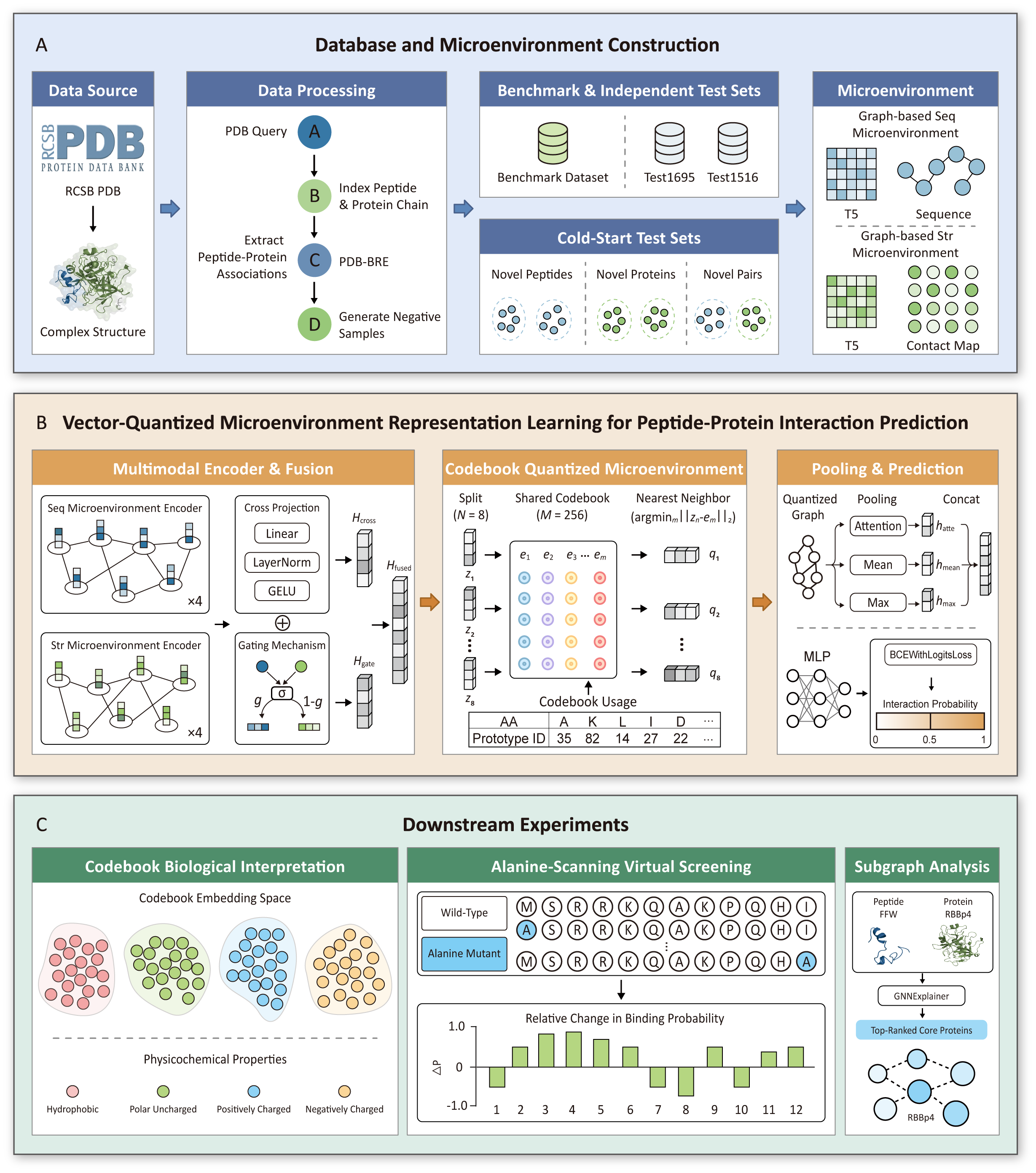
Figure 1. Overall architecture of VQM-PepPI for PepPI prediction. The workflow comprises three main phases: (A) Database and Microenvironment Construction, (B) Vector-Quantized Microenvironment Representation Learning and (C) downstream functional validation.