Introduction
DECANT: Decoupling mechanism from context in single-cell drug perturbation representation
Motivation: Single-cell chemical perturbation profiling offers a powerful opportunity to organize drugs by shared biological mechanisms, but observed transcriptional responses are entangled with contextual variation from cell identity, dose and treatment time. As a result, models that perform well in perturbation-response prediction may still learn latent spaces dominated by context-associated structure rather than transferable drug-associated signal. We developed DECANT to learn mechanism-oriented drug representations that remain stable across context shifts while preserving response fidelity.
Results: DECANT represents each perturbation as a matched treated-control cell set and separates a context-suppressed mechanism latent representation from context-dependent response information. The resulting drug-level mechanism space is shaped to support retrieval and biological interpretation. Under a fixed drug-level unseen-compound benchmark, DECANT achieved the strongest overall response-difference profile among adapted published perturbation models and strong pseudo-bulk baselines across gene- and program-level metrics. Beyond prediction, DECANT produced embeddings that remained stable across changes in dose, cell line and treatment time, recovered mechanism-family-coherent drug neighborhoods, and linked these neighborhoods to interpretable downstream consequence programs. Ablation analyses showed that mechanism-context decoupling provided the main signal-separation backbone, whereas retrieval-oriented shaping was critical for organizing local mechanism-space geometry. These results support DECANT as a framework for learning context-robust, mechanism-aligned drug representations from single-cell chemical perturbation data, providing a basis for mechanism-guided perturbation analysis and compound prioritization.
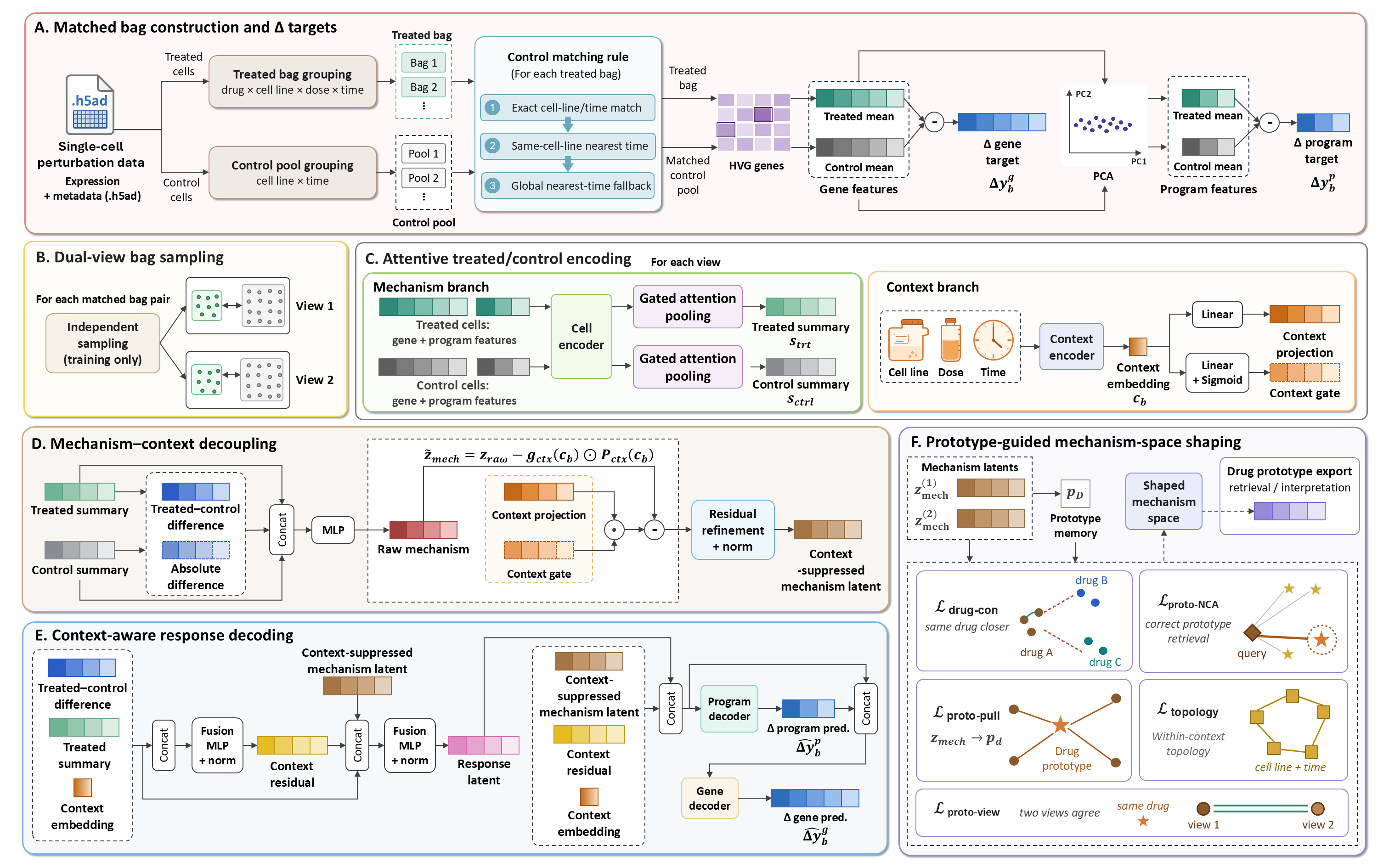
Fig. 1. Overview of the DECANT framework. (A) Single-cell perturbation profiles are organized into matched treated-control bags, and bag-level gene and program perturbation targets, Δybg and Δybp, are defined as treated-minus-control differences. (B) Two stochastic views are independently sampled from each matched bag pair during training. (C) Treated and matched-control cells are encoded by a shared cell encoder and summarized by gated attention pooling, while cell line, dose and treatment time are encoded as context variables. (D) A raw perturbation representation is converted into a context-suppressed mechanism latent by subtracting a gated context projection and applying residual refinement. (E) A context-aware decoder combines the mechanism latent with context-residual information to predict program-level and gene-level perturbation responses. (F) The mechanism space is shaped by prototype-guided contrastive, retrieval, view-consistency and topology-aware objectives, enabling drug prototype export for retrieval and interpretation.