About MultiDisoPred
Intrinsically disordered regions (IDRs) are widely distributed in proteins and are closely associated with regulation, recognition, and binding functions. Accurate prediction of IDRs and their binding functions is critical for protein structure and function analysis. Previous studies have typically employed a variety of amino acid features as semantic cues to represent protein sequences. However, different feature extraction strategies often encode distinct and partially overlapping residue-level context for the same protein sequence. How to effectively capture complementary, redundant, and synergistic relationships among these heterogeneous representations and integrate them into predictive models remains a significant challenge.
In this study, we propose MultiDisoPred, an interpretable multi-feature expert model for accurate prediction of intrinsically disordered regions and binding functions. MultiDisoPred integrates three complementary residue-level aspects, including Position-Specific Scoring Matrix (PSSM)-based evolutionary profiles, embeddings from a general pretrained protein language model, and embeddings from a disorder-focused protein language model. An interaction-aware mixture-of-experts module is introduced to explicitly disentangle feature-specific, shared, and synergistic contributions, while a lightweight re-weighting module assigns sample-specific expert weights to combine expert outputs into final predictions. Experimental results on multiple independent benchmark datasets demonstrate that MultiDisoPred performs comparably to or better than existing methods for both disorder and binding function prediction, while providing interpretable insights into the contribution of each expert.
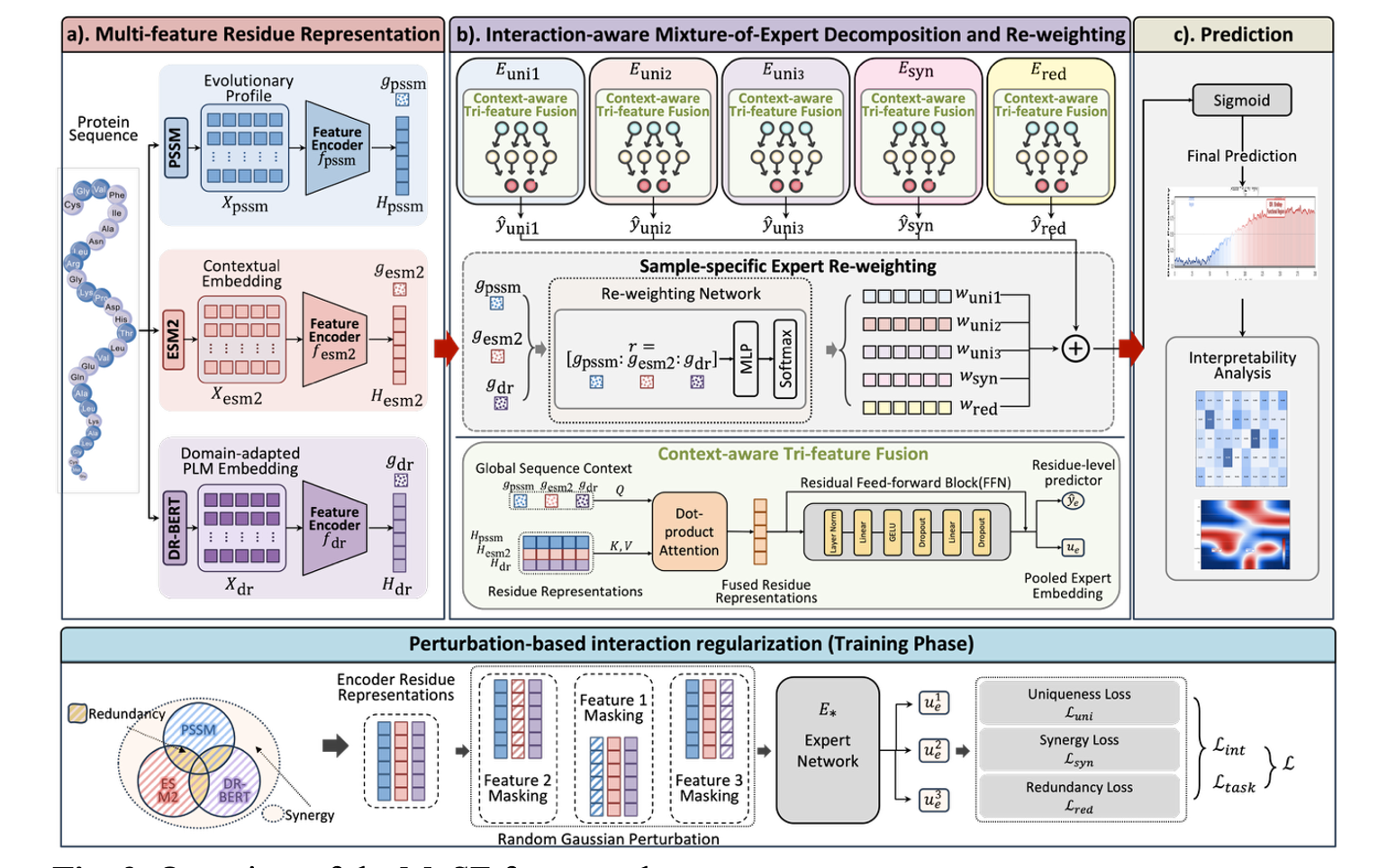
Overview of MultiDisoPred. MultiDisoPred integrates three residue-level feature views, including PSSM-based evolutionary profiles, ESM2 contextual embeddings and DR-BERT disorder-adapted embeddings. (a) Each feature view is encoded by an independent feature encoder to obtain residue-level representations and global sequence embeddings. (b) The encoded representations are passed to an interaction-aware mixture-of-experts module, which decomposes multi-view evidence into feature-specific, synergistic and redundant components. A sample-specific re-weighting network adaptively combines expert outputs, while each expert uses context-aware tri-feature fusion to generate residue-level logits and pooled expert embeddings. During training, perturbation-based interaction regularization guides the experts to learn distinct interaction roles. (c) The weighted expert outputs are combined and transformed by a sigmoid function to produce final residue-level prediction scores.