About cat-Fusion
Liquid–liquid phase separation (LLPS) drives the formation of membraneless biomolecular condensates and plays important roles in diverse biological processes. Accurate prediction of protein LLPS propensity is therefore important for understanding protein function and elucidating disease-associated mechanisms. Existing predictors typically rely on expert-derived biophysical features or learned sequence representations, yet effective integration of these heterogeneous information sources remains challenging. In particular, simple or static fusion strategies may fail to explicitly model their interactions and adapt their relative contributions to individual proteins, limiting the exploitation of complementary biophysical and contextual information.
In this study, we propose cat-Fusion, a dual-branch deep fusion network that integrates expert-derived biophysical features with contextual representations contextual representations learned by a pretrained protein language model. cat-Fusion comprises a cross-attention branch that explicitly models interactions between the two representation types and a gated regulation branch that uses global biophysical context to adaptively modulate semantic feature channels. A cosine similarity-based orthogonal regularization term is further introduced to encourage the two branches to learn complementary and non-redundant representations. Experimental results on a rigorously curated non‑redundant test dataset demonstrate that cat‑Fusion consistently outperforms existing LLPS predictors (e.g., AUROC of 0.822 and MCC of 0.491). Comprehensive ablation studies demonstrate that the cross-attention and gated regulation branches capture complementary predictive information and that their cooperative fusion substantially improves prediction performance.
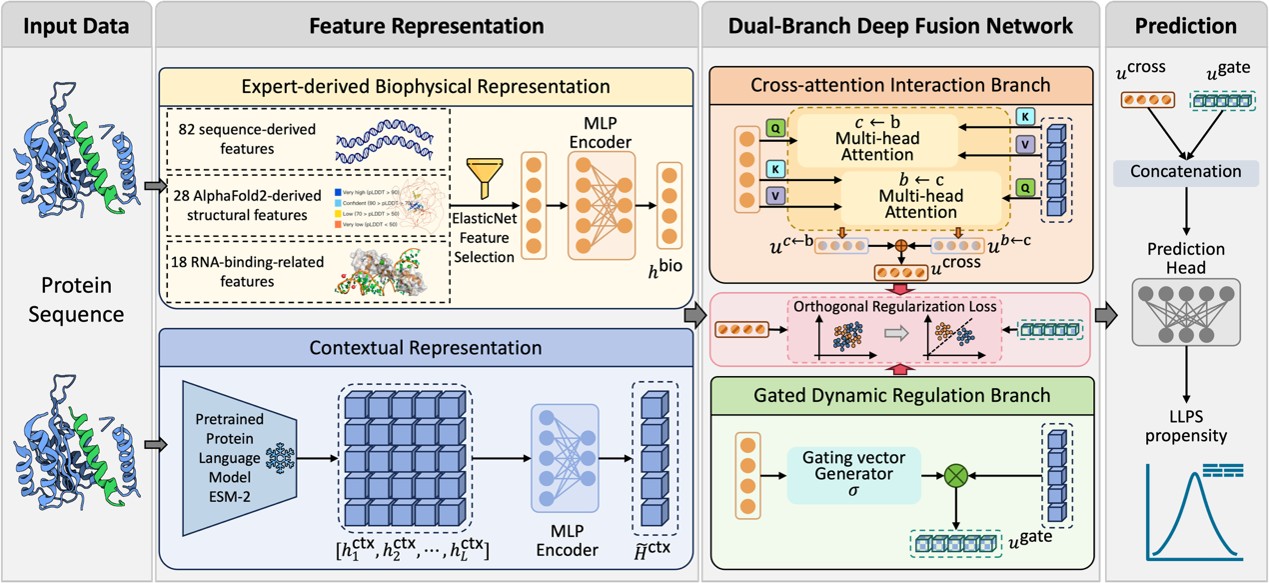
Overall architecture of cat-Fusion for protein LLPS propensity prediction. cat-Fusion integrates expert-derived biophysical features and ESM-2-derived contextual representations through a dual-branch deep fusion network. The cross-attention branch models interactions between the two representations, while the gated regulation branch adaptively modulates contextual features using global biophysical information. An orthogonal regularization term encourages complementary representation learning, and the fused features are finally used for LLPS propensity prediction.