Multiview tokenization
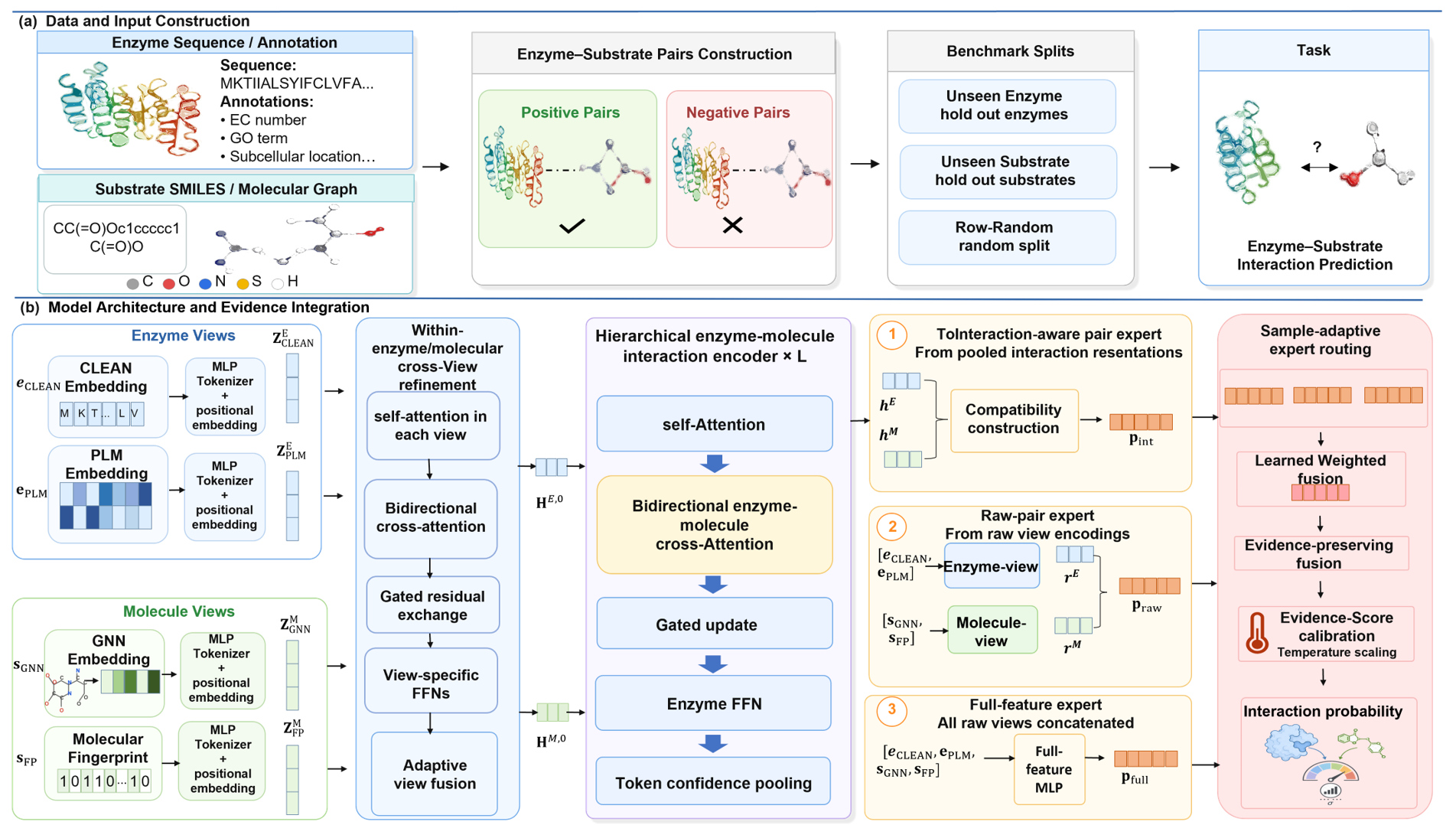
CLEAN and protein language-model embeddings describe the enzyme; GNN-derived molecular embeddings and Morgan fingerprints describe the substrate.
Enzyme intelligence · Multiview learning · Biocatalytic discovery
An Adaptive Multiview Interaction Framework for Enzyme–Substrate Compatibility Prediction and Biocatalytic Discovery
Research overview
Motivation. Predicting enzyme–substrate compatibility is central to enzyme discovery and biocatalyst development, yet catalytic specificity depends on pairwise interactions between heterogeneous enzyme and molecular representations. Existing methods often rely on static feature fusion or a dominant representation source, limiting the use of complementary biochemical evidence and generalization to unseen enzymes or substrates.
Approach. AIMS-ESI—Adaptive Interaction Modeling with Multiview Synergy for Enzyme–Substrate Identification—combines within-branch view refinement, hierarchical bidirectional enzyme–molecule interaction, and sample-adaptive evidence routing to learn pair-specific compatibility.
Results. Across 114,890 enzyme–substrate pairs, AIMS-ESI delivered consistently strong performance under unseen-enzyme, unseen-substrate, and row-random evaluations. It further generalized to cytochrome P450 prediction, polymer-specific enzyme prioritization, and reaction- and pathway-level retrieval.
Model architecture
Protein semantics and molecular structure are refined within their own branches, exchanged through stacked bidirectional interaction blocks, and integrated by a sample-adaptive router.
Core design
CLEAN and protein language-model embeddings describe the enzyme; GNN-derived molecular embeddings and Morgan fingerprints describe the substrate.
Within-branch refinement and stacked bidirectional cross-attention progressively resolve pair-dependent enzyme–molecule compatibility.
A sample-specific router weights interaction-aware, raw-pair, and full-feature evidence before calibrated probability prediction.
Evaluation
Benchmark summary
The model achieved the highest value across all four reported metrics on the unseen-enzyme and row-random splits, and led accuracy, MCC, and F1 on unseen substrates.
| Evaluation split | ACC | AUROC | MCC | F1 |
|---|---|---|---|---|
| Unseen enzyme | 0.9337 | 0.9741 | 0.8671 | 0.9428 |
| Unseen substrate | 0.9671 | 0.9937 | 0.9342 | 0.9708 |
| Row random | 0.9694 | 0.9949 | 0.9359 | 0.9748 |
| Cross-split mean | 0.957 | 0.988 | 0.912 | 0.963 |